
The Architect’s Verdict:
Static vs. Dynamic.
In the 2026 Rwandan digital economy, choosing between a static and a dynamic build is not an aesthetic choice—it is a strategic decisionthat defines your organization’s performance, security, and growth ceiling.
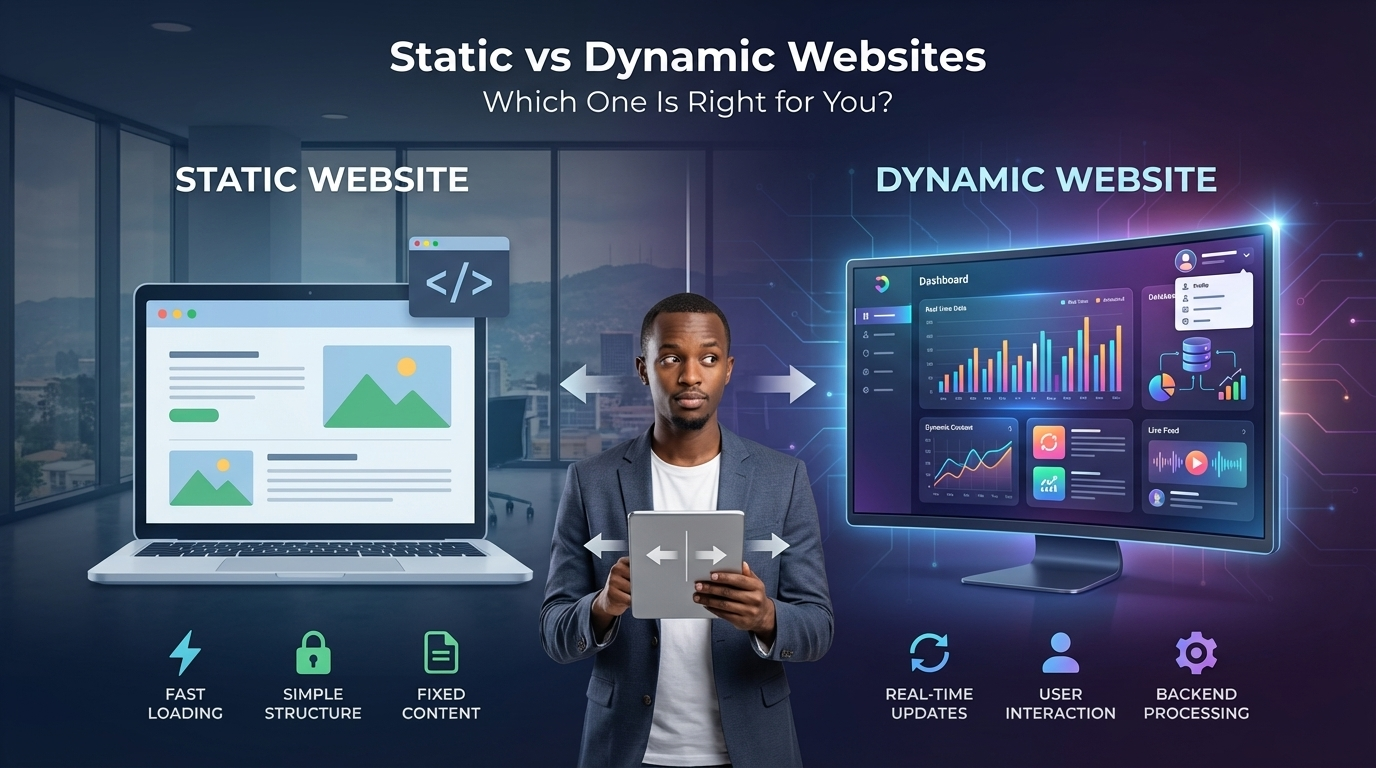
Imagine you are sitting in a boardroom in Nyarutarama, planning the next three years of your organization’s growth. Your lead developer asks: “Do you want a static site or a dynamic system?” For many leaders, the question sounds technical and secondary. But here is the 2026 reality: that single choice determines if your website will be a high-performance digital asset that captures market share, or a slow digital liability that drains your administrative budget.
In the Rwandan market, where connectivity ranges from blazing-fast fiber in Kigali to spotty 3G in the provinces, the architecture of your site is the definitive boundary of your Technical Sovereignty. A static site is a pre-rendered fortress of speed and security, ideal for building institutional authority. A dynamic site is a living engine, mandatory for handling MTN MoMo payments, student records, or complex inventory.
At Toni Tech Solution, we recognize that your technology must be fit-for-purpose. This exhaustive guide is designed to strip away the jargon and provide the strategic clarity needed to architect your 2026 digital headquarters. We will explore the anatomy of both systems, why a unified high-performance web engineering approach is required, and how the right choice can reduce your operational expenses by 20% to 60%.
1. The Anatomy of a Request:
How the Modern Web Actually Works.
To understand the difference between static and dynamic, we must first understand what happens when a user in Kigali types your URL into their browser. Every digital interaction is a “Request” from a client (the user’s phone) to a “Server” (a computer in a data center). In the 2026 digital landscape, this request travels through a complex web of fiber optics and satellite nodes before reaching its destination.
The speed of this request is defined by Latency. In Rwanda, latency varies significantly. A user at a cafe in Kimihurura has high-speed access, while a business partner in a rural district might be relying on a fluctuating 4G signal. The architecture you choose determines how much “work” the server has to do before it can respond to that request.
The Static Model
Think of this as a pre-printed brochure. When the user requests a page, the server simply picks up a file that is already “printed” and sends it. It is instant because there is no “thinking” or database searching involved. This is the hallmark of SSG (Static Site Generation).
The Dynamic Model
Think of this as a custom meal ordered in a restaurant. When the user requests a page, the server has to “cook” it—checking a database, running logic, and building the page specifically for that user. This is SSR (Server-Side Rendering), mandatory for real-time data.
In the Rwandan context, “thinking time” is the enemy of conversion. If your server is located in Europe or the US, and it has to “cook” a page before sending it back over the ocean, the user experience will be sluggish. This is why our modernization roadmaps leverage Edge-First Engineering to ensure your response time is measured in milliseconds, not seconds.
2. Static Websites:
The High-Performance Authority Fortress.
A static website in 2026 is no longer a simple HTML file. It is a high-performance asset pre-rendered using advanced frameworks like Next.js 15. This means the Faceof your site is built during the “Build Phase,” long before the user ever arrives.
The 2026 Advantage: Technical Sovereignty
For Rwandan institutions like legal firms, high-end construction companies, and regional NGOs, your primary digital goal is to build Instant Credibility. Static architecture provides a “fortress” for your reputation, ensuring that no matter how much traffic you receive, your site remains stable and fast.
Velocity Benchmarks
Static pages achieve sub-500ms Largest Contentful Paint (LCP). In the 2026 search economy, Google's algorithm explicitly rewards this speed with higher rankings. If you want to dominate Kigali search results, static is your primary weapon. See our SEO engineering suite.
Security Immunity
With no active database or server-side processor exposed to the web, the attack surface is virtually zero. Static sites are inherently compliant with the most rigorous data protection standards in Rwanda. Explore our security audit.
Case Study: The NGO Impact Portal
Consider an NGO working on conservation in the Virunga Mountains. Their site doesn't need complex user logins; it needs to show stunning visuals, impact reports, and donation links to a global audience. By architecting this as a Static Asset, we ensure that the site loads instantly for a donor in London, while also being accessible to a field worker in Musanze on a limited data plan.
By stripping away the unnecessary logic, we focus 100% of the browser's resources on rendering the Authority Signal. This is the hallmark of professional web engineering.
3. Dynamic Websites:
The Operational Brain of the Institution.
While static sites are built before requested, a dynamic website is a “Living Engine.” It handles logic, processes user data, and responds to unique inputs in real-time. This is the architecture required for custom business systems, ERPs, and patient portals in the 2026 Rwandan digital economy.
Dynamic architecture uses Server-Side Rendering (SSR). When a user in Kigali requests their banking profile, the server must verify their identity, fetch their balance from a database, and “paint” the page specifically for them. This flexibility is what allows for the automation of complex Rwandan business processes.
The 2026 Logic Stack
MoMo API Interactivity
Real-time payment reconciliation and ledger updates.
Institutional Personalization
Customized dashboards for students, staff, or clients.
Real-Time Inventory Sync
Automated stock management for e-commerce and logistics.
Compliance Logic Hub
Dynamic enforcement of Law No. 058/2021 data handling.
Case Study: The School Management System
An international school in Kigali requires more than an “information site.” They need a dynamic portal where parents can view grade reports, teachers can upload assignments, and admin can track fee payments via MTN MoMo.
This level of interactivity is where dynamic architecture shines. By building a custom bespoke system, we ensure that your school's data is locked behind secure authentication while remaining instantly accessible to those with the correct permissions.
4. The Hybrid Solution:
The “Best of Both Worlds” Approach.
In the 2026 engineering suite at Toni Tech, the choice is no longer Binary. Most world-class Rwandan organizations now utilize Hybrid Architecture. This is made possible by Next.js 15's partial prerendering.
In a hybrid model, we pre-render your high-traffic marketing pages (Home, About, Blog) as Static Assets for maximum speed and SEO. Simultaneously, we reserve Dynamic Rendering for interactive clusters like your checkout page, user dashboard, or booking calendar.
Why Hybrid is the 2026 Standard
It allows an organization to have the Search Authority of a static site with the Operational Power of a dynamic system. You gain the 500ms load times of SSG while retaining the ability to process insecure MoMo transactions on the fly.
5. The Strategic Decision Matrix.
Choosing your architecture is a function of your Institutional Purpose. Use the following framework to audit your requirements.
| Requirement | Static (SSG) | Dynamic (SSR) |
|---|---|---|
| SEO Priority | Extreme High | Variable / Moderate |
| Data Security | Fortress (Air-Gapped) | High (Requires Stewardship) |
| Operational Complexity | Low (Information-Focused) | Elite (Interaction-Focused) |
| Page Load Velocity | < 1.0s | 1.5s - 3.0s (Average) |
| Maintenance ROI | Automatic Maintenance | Continuous Stewardship |
The Architect’s Perspective:
TUYISHIMIRE Emmanuel (Toni).
“Architecture is the soul of performance. In the 2026 Rwandan digital economy, choosing between static and dynamic isn't just a technical decision; it's a financial one. At Toni Tech Solution, we don't just deliver code; we deliver Structural Intelligence. By matching the right architecture to your operational goal, we ensure you never pay for logic you don't use, and never lose speed you can't afford.”
— Founder & CEO, Toni Tech Solution
Architecture Intelligence FAQ.
Strategic technical guidance for Rwandan leaders choosing between speed and logic in the 2026 digital economy.
Architect Your
Digital Reality.
Stop building liabilities. Start architecting a digital headquarters that reflects your professional scale and operational ambition. Contact Rwanda’s premier technology partner today.
Strategic Architecture Desk
contact@tonitechsolution.com
Kigali, Rwanda